Master of Forestry (MF)
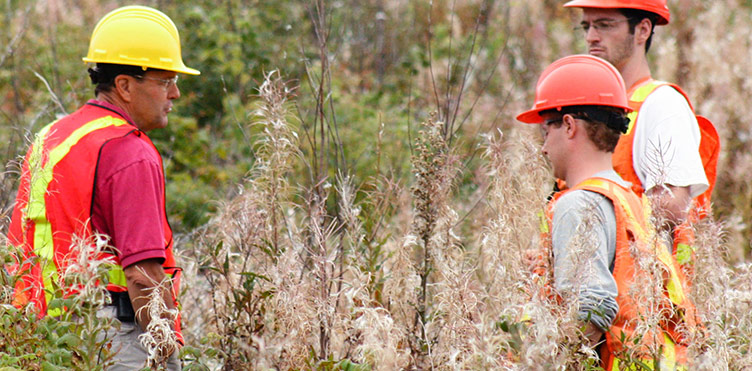
In the MF program, you will study forestry at an advanced level through approved course work and by completing and presenting a major research report on a topic you and your supervisors develop.
You will have the opportunity to study in a number of areas that are important to the forestry industry including forest management, forest fire and insect management, climate change, wildlife conservation and innovative wood products.
Typically, MF students are largely self-funded, with some research assistance funding provided through the Faculty (~$3K), and you have the option of studying full-time or part-time.
There are two options within the Master of Forestry graduate program.
1-year report-based Master of Forestry
This 12-month MF option is ideal for individuals who already hold a forestry undergraduate degree and are seeking to enhance their expertise at the graduate level.
Program highlights
- 24 credit hours (ch) of graduate-level and upper-year undergraduate coursework tailored to your technical and professional interests.
- A research report completed under the guidance of a faculty supervisor and a supervisory committee.
- Flexible course selection including graduate (5000 or 6000) and select undergraduate (3000 or 4000) courses.
- Opportunity to take relevant courses from outside the Faculty in consultation with your supervisor.
Funding and awards: All MF students receive a guaranteed Graduate Research Assistantship (GRA) valued at approximately $4,000–5,000. In addition, students are eligible for entrance scholarships and competitive merit-based awards.
16-month report-based Master of Forestry
Registered Professional Forester (MF-RPF) stream
The 16-month MF-RPF program is a professionally focused, course- and report-based master’s degree tailored for individuals who do not have an undergraduate degree in forestry.
This includes recent graduates in the natural or life sciences, as well as mid-career professionals already working in the forest sector who want to become a Registered Professional Forester (RPF) without completing a 4-year undergraduate program.
Program highlights
- Structured coursework that meets RPF competency requirements across Canadian provinces.
- A summer internship that culminates in the development of a Forest Stewardship Management Plan.
- A professional report under the direction of a supervisor and supervisory committee.
- Summer internship placements are typically paid; although not guaranteed, we work closely with students to secure positions.
Funding and awards: All MF-RPF students receive a guaranteed Graduate Research Assistantship (GRA) valued at approximately $4,000–$5,000. In addition, students are eligible for entrance scholarships and competitive merit-based awards.
MF-RPF admission requirements
- Applicants must submit a completed application. Preference will be given to those students who apply before March 31.
- Applicants must have an academic background (bachelor’s degree) in a relevant field such as forestry, environmental science, computer science, geology, or geography (minimum B, or cumulative 3.0 GPA). Including completion of a basic/intro statistics course.
- Applicants must have an Introduction to GIS course, or equivalent.
- Applicants whose first language is not English must submit language scores that meet or exceed international English language testing system (IELTS) band 7.
- Applicants must provide evidence of a working understanding of computer systems, such as understanding basic operating systems (Windows, MacOS), spreadsheets (Excel) and word processing.
- Highly desirable skills include technical writing skills, effective communication, experience with computer coding or scripting.
List of required courses
- ENVM*6000: Indigenous Issues and Perspectives in Natural Resources Stewardship
- FOR*6001: Introduction to Forestry
- ENVM*6003: Advanced Management Skills in Forestry and Environmental Management
- FOR*6005: Silviculture and Stand. Intervention Design
- FOR*6006: Forest Management Foundations
- FOR*6013: Woodlot Management and Professional Forestry
- FOR*6096: Advanced Topics in Forest Managements
- ENVM*6703: Forest Operations
- FOR*6996: MF Stewardship Management Report
Part-time study option
Students in either MF program can opt for part-time studies, which is ideal for working professionals.
Career outcomes
Forestry remains one of Canada’s top-ranking professions, with growing demand for skilled professionals. The MF and MF-RPF programs prepare graduates for a wide range of careers in sustainable resource management, forest policy, industry leadership, and conservation.
Potential career paths
- Forest operations and planning
- Silviculture and reforestation
- GIS and remote sensing
- Forest policy and regulation
- Urban and community forestry
- Carbon and climate forestry
- Biodiversity conservation
For up-to-date job listings and labour market trends in the forestry sector, see Job Bank Canada – Forestry
Next steps
Take the next steps to advance your education and career