Robert J. Collier VE9UNB Memorial Station
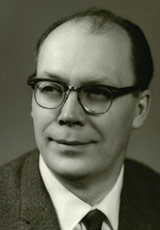
The Robert J. Collier VE9UNB Memorial Station facilitates UNB's Amateur Radio Club and is named to honour the former Professor of Electrical Engineering at the University of New Brunswick. In 1968, he died at the age of 47.
While he was at UNB, his contributions included the development of a microwave system used by NBTel, as well as RCMP radar systems. Bob Collier, VE1RC, was a unique individual and scholar at a time when uniqueness was valued and even treasured.
He was full of curiosity about technical matters in Electrical Engineering and he encouraged the students to wonder, question and most of all to think.
He was always accompanied by his pipe, although not necessarily with ample tobacco. He used to scrape out the inside of his pipe with a small jack knife and light up the residue. Technical conversations with him were always quite lengthy and since the pipe residue did not always stay lighted, it was not uncommon to find a neatly structured pile of spent matches on the lab bench where the conversation was taking place.
As a hobby he grew roses, which year after year won prizes at the Fredericton Exhibition. He was greatly admired and respected by his students. The R. J. Collier Scholarship tries to foster his attributes through the recipients chosen for it.
Rewind highlights
Awards
Worked All States (WAS) Mixed Award
The UNB Amateur Radio Club in the Robert J. Collier VE9UNB Memorial Station received the ARRL's Worked All States (WAS) Mixed Award #62094 on Aug. 22, 2018.
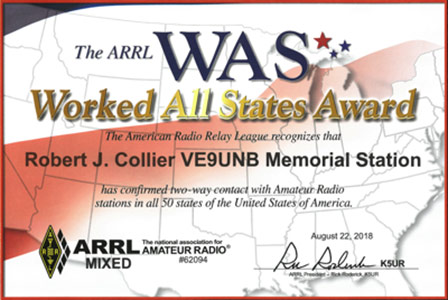
For each year from 2013 to 2018, VE9UNB participated in the ARRL's Sweepstakes SSB radio contest and has QSLs with 48 states.
In 2017, we obtained an FT8 QSL with Oklahoma. Finally, under VE1UNB, a former call sign, we have a QSL with Arkansas from 1978.
All QSLs are in the ARRL's Logbook of the World. The ARRL's Worked All States (WAS) Mixed Award is a result of the work of many student amateur radio operators over 40 years.
DX Century Club Award
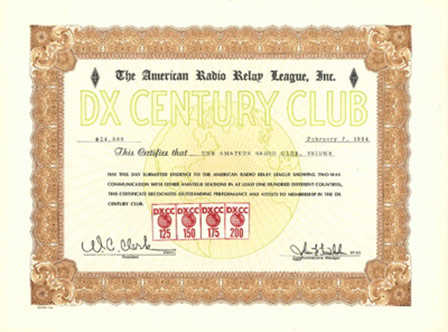
This is the 1984 award certificate for the DX Century Club, showing VE1UNB having worked 200 DX entities. It is certificate #24,889, issued Feb. 7, 1984, in the name of the UNB Amateur Radio Club, VE1UNB.
The certificate shows V. C. Clark, W4KFC, ARRL President and John F. Lindholm, W1XX, ARRL Communications Manager.
VE1UNB ARRL Affiliation Certificate
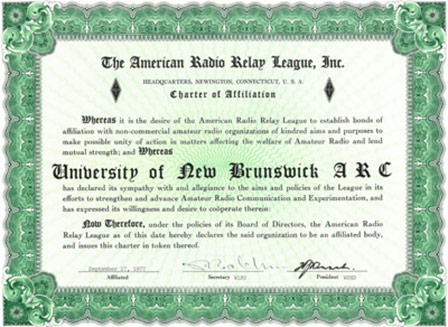
The affiliation certificate is signed by Harry J. Dannals, W2HD, Former ARRL President and Richard Baldwin, W1RU, Former ARRL Secretary, ARRL General Manager and IARU President; dated Sept. 17, 1977.
CQ WW WPX CW Award
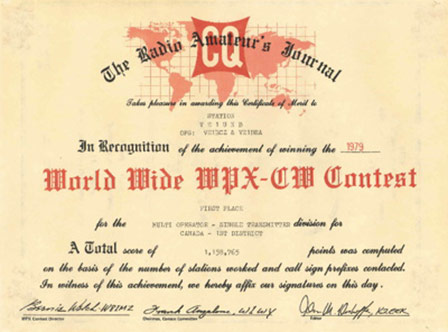
This is the award certificate for the station VE1UNB from the 1979 CQ World Wide WPX-CW Contest.
The two operators' call signs are not easily read from the image, but they were VE1BCZ (Steve Kavanagh, now VE3SMA) and VE1BHA (John Connor, now VE3TG).
Ten-Ten International Radio Club Certificate
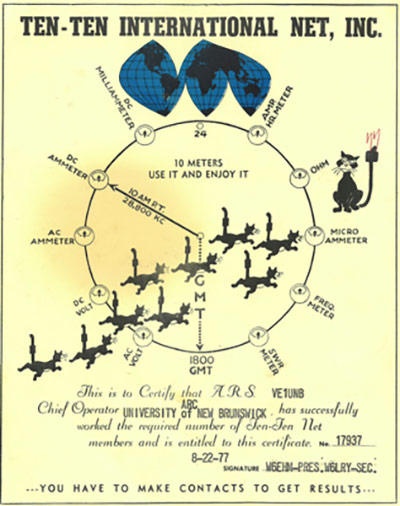
A Ten-Ten International Radio Club certificate is in the shack, issued on August 22, 1977, 10-10 number 17937, currently held by VE9UNB.
1948
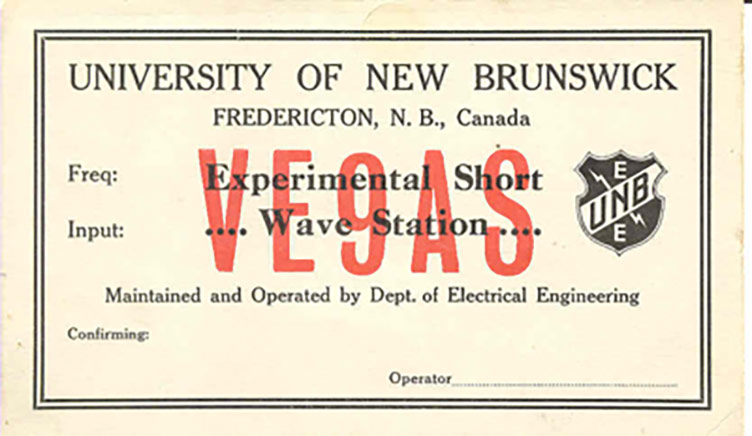
Foster Baird's VE9AS QSL Card
The UNB Amateur Radio Club was founded in 1948. The call signs that have been used by the station are VE1RK and VE1UNB; the current call signs are VE9UNB and VE9YFC.
Foster Baird, Professor of Electrical Engineering, Dean of Engineering, 1948 Acting President of the University of New Brunswick, was likely the holder of the call sign for VE9AS, an experimental station.
This call sign was issued many decades before the province of New Brunswick started using the VE9 prefix for its amateur radio certificates.
Foster Baird had a teaching style with similarities to that of Robert J. Collier, in that they would spend a great deal of time in the lab working with the students.
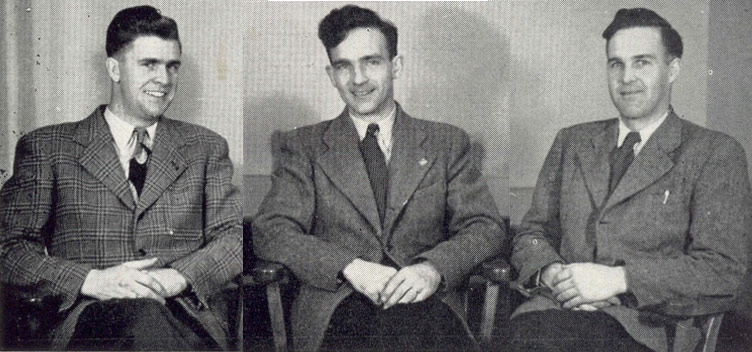
Archie Philips, Vice-President, George Ruickbie, President and Alan Strang, Secretary-Treasurer, VE1RK
The UNB Up The Hill Yearbook, 1948-1950 and 1952-1953, has more information and photographs from the initial years of the club.
Radio club
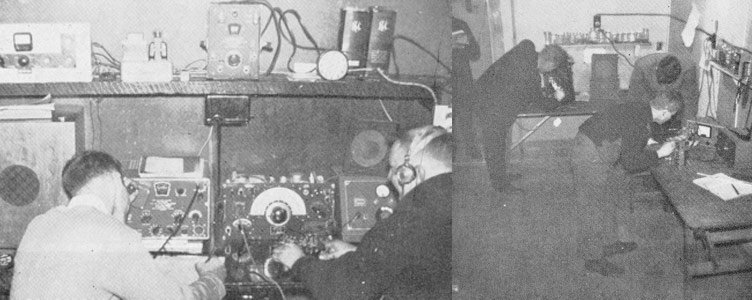
With the large influx of amateur radio "hams" and ex-service "key-bashers," it required little impetus to give birth to a new organization on the campus, namely the University Radio Club. The actual organization of the club began in the spring of 1947, but official recognition by the S.R.C. was not granted until this year.
Although the pioneer work of getting started was carried out by the students already experienced in amateur radio, it was strongly emphasized from the beginning that the new club would particularly welcome beginners and all those interested in radio.
Facilities for the club were obtained at Alexander College and with the able help of the members, an excellent club room and workshop were soon functioning. To enable members to qualify for their amateur operating licenses, code and theory classes were held twice weekly under the supervision of other members.
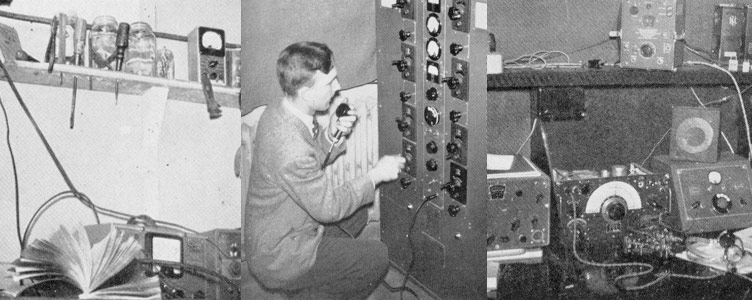
A powerful transmitter was built by the members with the club bearing over 50$ of the expenses. A complete system was installed and, with this excellent equipment, UNB went on the air. In the first month of operation, nine countries, all provinces and twenty-two states in the U.S.A. were "worked." Meetings were held three times monthly when electronic films were shown and guest speakers gave interesting talks.
UNB holds with the University of British Columbia, the distinction of being one of the first two clubs in the Dominion-wide University radio networks. The club has enjoyed an excellent "freshman" year, and its success augurs well for all student radio enthusiasts in the years to come.
1949
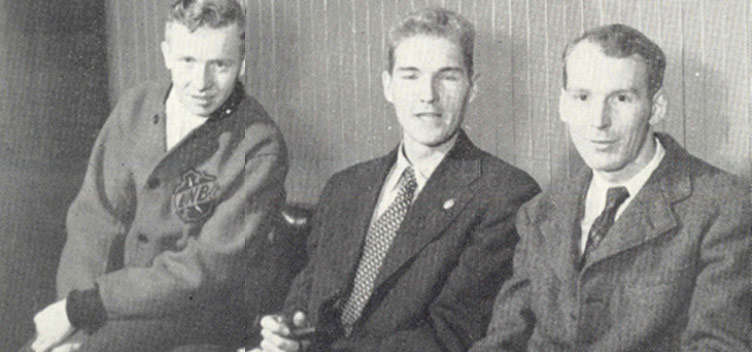
W. I. Aubin Treasurer, D. T. Dunwoody President, J. K. Creelman Vice-President, VE1RK
VE1RK: This is the call sign or identification log of the U.N.B. Radio Club. Since its organization in the fall of '47, it has accelerated forward with leaps and bounds. Today it can boast a substantial membership of ham operators, skilled electrical technicians, and notice in the Radio field. These lads have for their stamping ground, an excellent workshop at Alexander College with full facilities for delving into the mysteries of electronics.
A few of the "brains" even went so far as to completely design and build their own H. F. Transmitter, from antenne coil to oscillator. This mated with our new communications receiver, make a superb combination for our hams to work the air waves. A key and audio oscillator make it possible for those red hot key bashers to get up speed on their Morse.
This year, many highly entertaining and enlightening tours were arranged for club members. C.F.N.B., and the N. B. Telephone Commission both acted as very genial hosts to over 60 Electrical students and gave us an insight into their respective lay outs.
Films have been a popular feature of the bi-monthly meetings, and the fields of electronics and atomic physics, have thus been invaded by routes less devious than the text book.
The clubs programme has been nicely rounded out by a number of social functions, usually skating and dancing parties at Alex, and the attendance runs close to 200. Our newly inaugurated bowling team completes the social life of the club.
For the future, the club has extensive plans, and for the present, bids to all, a sincere and hearty welcome.
1950
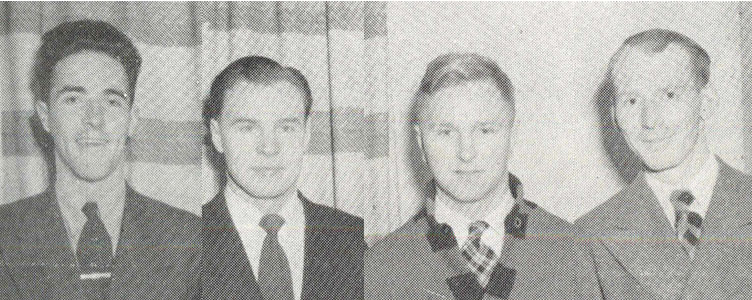
Dick Gale, Bob MacLean, Bert Cosman, Ken Creelman (Pres.), VE1RK
UNB Radio Club has had its third successful year. The club rooms and workshop were maintained at Alexander College as in other years. Radio construction work was carried on in the workshop by members although the operation of our amateur station VE1RK was limited.
The falling off in "ham" operating was mostly due to the fact that most of the licenced amateurs are senior electrical students who could not afford the time. It is fortunate that the club rooms at Alexander may be used for another year as space "Up the Hill" is unavailable as yet.
A dance, as is our usual custom, was held at Alexander College Common Room for the purpose of supplementing our SRC grant.
Three tours were made this year by the club members, all of which were extremely interesting. The first was a visit to the Canadian Broadcasting Corporation plant at Sackville made at the time of the UNB/-Mt. A. football game. At the C.B.C. three 50,000 watt transmitters and associated equipment were examined. This plant is the only one of its kind in Canada and includes the transmitting facilities of the C.B.C.'s International Service.
During the winter the radio and teletype equipment of the New Brunswick Area Army Headquarters were shown to us. Later a tour of the New Brunswick Telephone Company building was conducted. There, the dial system, toll, teletype and testing equipment was demonstrated. At all of these places we were received very kindly and answers given to our endless questions.
During our meetings, which were held about every three weeks, films on radio and general interest topics were usually shown.
1952
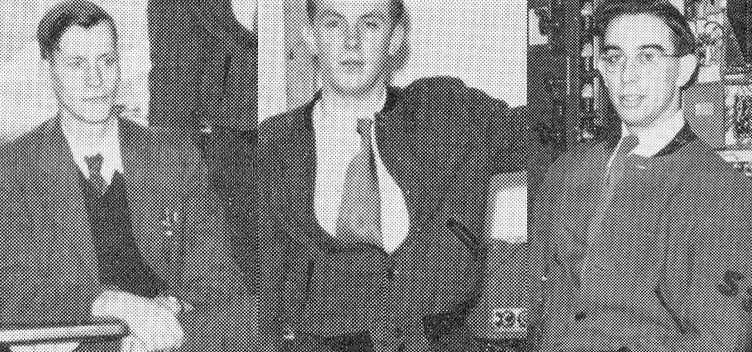
UNB Radio Club has had another successful year, and has now been active for five years. Membership for 1951-2 rose above last year's total, and interest in the Club has been high. Our future looks promising.
The highlight of the year's activities was the moving of the Club headquarters from Alexander College to a room in the Electrical Building. The space was made available by the kindness of the Electrical Engineering Department.
The Club's transmitter, VE1RK, has been in operation and contacts have been made with various parts of North America. Members wishing to obtain amateur transmitting licences have been able to practise Morse code on the Club's oscillator under the guidance of Professor Galbraith, who has generously devoted his time to help the Club in this respect.
We were fortunate in being given a tour of CFNB's studios and control rooms, and a goodly number of members and other electrical students turned out for this tour.
Meetings were held throughout the year, approximately once a month. At these meetings films were shown, and Professor Collier and Professor Galbraith very kindly gave us lectures on radio theory.
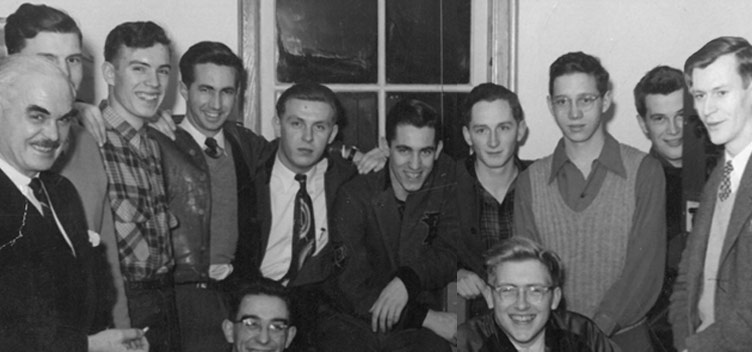
1953
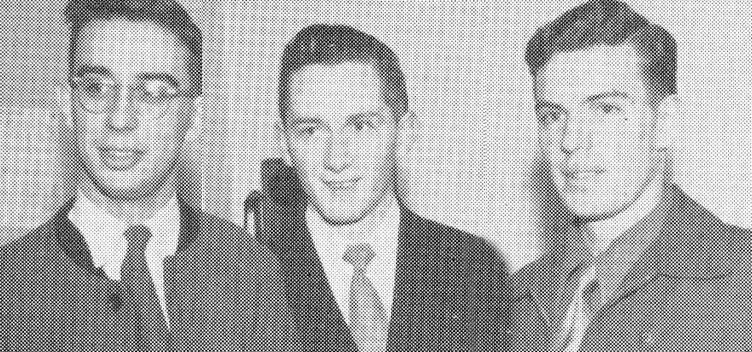
Bob Kavanagh (President), Don Dewey (Vice-President), Burke Swan (Secretary-Treasurer)
UNB Radio Club enjoyed a successful year, its first complete one in its new headquarters in the Electrical Building. Membership was again at a very satisfactory level.
New equipment was added to the club room including a large notice board and various tools. The major purchase of the year was a variable frequency oscillator for use with the club transmitter.
The club transmitter has been in operation during the year, although activity in that respect was somewhat diminished this year due to the lack of licenced operators. In conjunction with the Electrical Engineering Department, a new antenna was created for use both by the club and the Department.
Several members have been practising morse code, using the club's oscillator and one member, Bob Scott, has successfully passed the examination for his amateur transmitting licence.
Meetings were held approximately once a month throughout the year. At these meetings, files were shown and talk on various aspects of radio were given. Among the talk's heard by the club were: Prof. Collier on Teletype, Prof. Dineen (Dineen Memorial Lecture Series) on Radio Receivers, Leo Smitas on the Cathode Ray Oscillator and Don Weeks, CFNB studio engineer, on Tape Recorders.
1978
Photo credits: John Connor, VE3TG
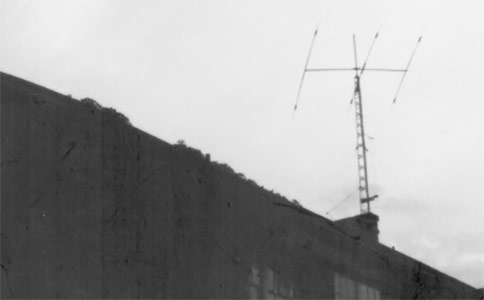
This is the TA33 antenna that provided a great deal of enjoyment and it worked all the DXCC entities.
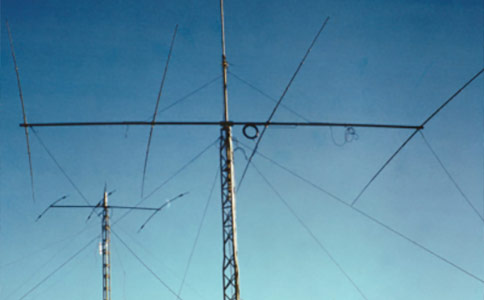
This was an upgrade to four elements on 20 m. In the image above, on the right, is a Wilson 4 element Yagi for 20 m. Photo taken during a transition of antennas. After that, the antennas on the towers had:
- 20 m - 4 elements
- 15 m - 5 elements
- 10 m - 5 elements.
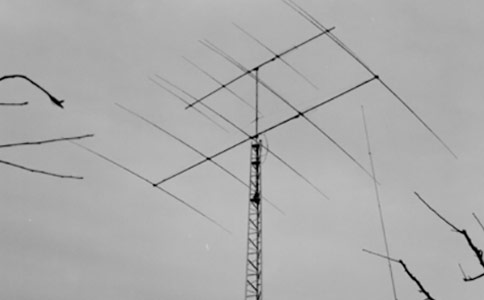
Monobanders on 15 m and 10 m were on the tower where the TA33 was. A project was started to upgrade the antennas around 1978, but like all antenna projects it went on longer than planned. Around the summer of 1980 some new antennas were put in place and they were used to good effect by club members in the 1980 CQ WW SSB to get a 2.6 M score.
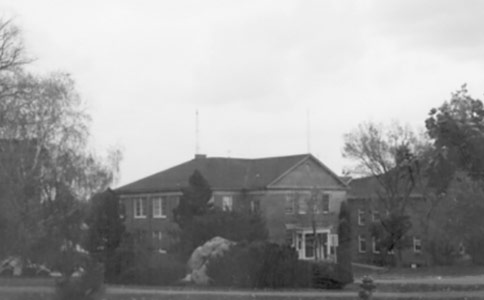
You can just barely make out the two towers gracing the roof of Head Hall. In downtown, in the right spot, you could see them.
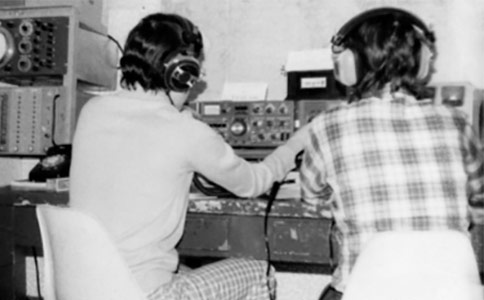
This is a typical view of a contest - the back of their heads, Craig, VE1QT, and Steve, VE1BCZ, in the contest. Note the nifty Star Trek chairs for the time. The scope in the rack could be a source of entertainment; after long exposure to the ceiling's fluorescent lights, at night the phosphor on the scope would glow a very nice ghostly horrible yellow.
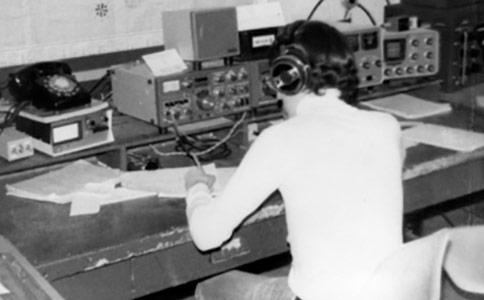
This is another view taken at 0400 during the ARRL 1978 DX Phone Contest; back then, it was two weekends long! Craig, VE1QT, is hard at work; he was the club president at the time. In the back corner you can see a Collins 51J4. Just in the bottom left corner of the picture you can see the ASR 28 Teletype.
Here's the line score from QST; that "96" is 96 hours. VE1UNB(VE1s BCZ BEC BHA BJC QT, oprs) 1,210,482-1478-273-C-96
The old shack location was at the top of the stairs in the south-west end of Head Hall.
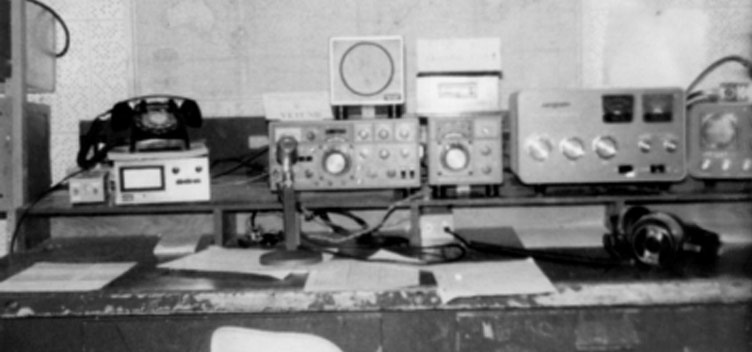
Photo description: From left to right
- Homebrew phone patch
- Rotor control box
- Black dial rotary phone, on the rotor box
- TS820S
- Separate VFO for the 820
- Tymeter clock on top of the VFO, a tymeter is shown at eham.net)
- SB220, put together by John
- Heathkit SB610 station monitor
- SWR meter on top of the station monitor
- Speaker on top of the rig