
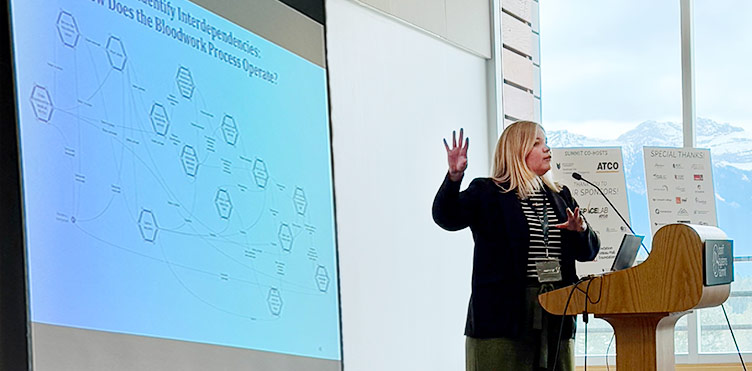
In our lab, FRAM is currently being used to examine, model, and analyze the process of how newcomers access and navigate primary care services in Fredericton, NB.
Through qualitative interviews and focus groups with both healthcare and settlement workers, we identified over 40 interconnected functions and instances of variability across the newcomer primary care process.
FRAM modelling and analysis revealed how systemic barriers, such as vague federal health data, coordination gaps, and role misalignment can propagate downstream and compromise care outcomes.
For example, ambiguity in initial health summaries from Immigration, Refugees and Citizenship Canada (IRCC) led to inefficient appointment scheduling, overburdened providers and mismatched services.
Conversely, system strengths such as language line interpretation, the resiliency of health and settlement workers and the involvement of the Multicultural Association of Fredericton (MCAF) supported effective care delivery.
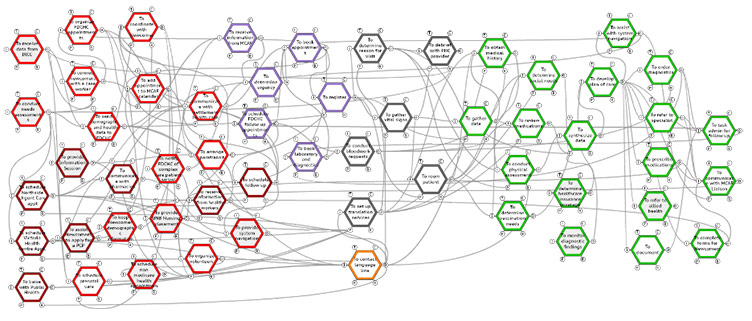
FRAM allowed us to visualize the ripple effects of performance variability, including both breakdowns and adaptive workarounds.
Health and settlement workers routinely engaged in hidden, compensatory tasks to support newcomers navigating a fragmented system. These insights informed 16 co-designed, multi-level recommendations to support integration across clinical, organizational, and policy levels.
The FRAM approach not only identified challenges but also revealed where system resilience exists offering a practical roadmap to redesign newcomer care toward a more coordinated, culturally safe and person-centered model of care delivery.
Mapping the way: functional modelling for community-based integrated care for older people. Health Research Policy and Systems, volume 22, 103 (2024). McGill, A., Salehi, V., McCloskey, R. et al.
Understanding the complexity of a stroke care system through functional modelling and analysis. Human Factors in Healthcare, 6, 100084, Salehi, V., Veitch, B., Smith, D., & McCarthy, J. (2024).
Modeling and analyzing hospital to home transition processes of frail older adults using the functional resonance analysis method (FRAM). Applied Ergonomics, 93, Salehi, V., Hanson, N., Smith, D., McCloskey, R., Jarrett, P., & Veitch, B. (2021).
Modeling complex socio‐technical systems using the FRAM: A literature review. Human factors and ergonomics in manufacturing & service industries. Salehi, V., Veitch, B., & Smith, D. (2021).
Building a functional resonance analysis method model: practical guidance on qualitative data collection and analysis. International Journal of Qualitative Methods. McGill, A., McCloskey, R., Smith, D., Salehi, V., & Veitch, B. (2023).
The functional resonance analysis method as a health care research methodology: a scoping review. JBI Evidence Synthesis, 20(4), 1074-1097. McGill, A., Smith, D., McCloskey, R., Morris, P., Goudreau, A., & Veitch, B. (2022).
A dynamic version of the FRAM for capturing variability in complex operations. MethodsX, 8, 101333. Salehi, V., Smith, D., Veitch, B., & Hanson, N. (2021).
Establishing trustworthiness in health care process modelling: a practical guide to quality enhancement in studies using the functional resonance analysis method. International Journal of Qualitative Methods, 22, McGill, A., McCloskey, R., Smith, D., & Veitch, B. (2023).
June 24 - 26, 2025 | Saint John, New Brunswick
“Building Resilience in Nursing Education and Newcomer Care: The Newcomer Integrated Health Initiative (NIHI)”
Sept. 13 - 15, 2025 | Niagara Falls, Ontario
“Refugees’ Challenges in Navigating the Canadian Healthcare System: A Case Study from Fredericton, New Brunswick”